Click, Click, Broke: How Gamers Are Dropping Rent Money on Keyboards (And Loving Every Second)
It begins innocently enough. You're mid-game, your fingers are flying, and suddenly you think: this keyboard feels like typing on wet bread. So you do a little Googling. Maybe watch one YouTube video. Two, tops.
Three weeks later, you're on Reddit at 2 a.m. debating the acoustic properties of POM versus polycarbonate plates with strangers from Ohio, and your cart has $340 worth of switches you haven't even touched yet.
Welcome, friend, to the mechanical keyboard hobby. Please leave your financial stability at the door.
So What Even IS a Mechanical Keyboard?
Great question. A mechanical keyboard uses individual physical switches under each key — as opposed to the rubber membrane situation hiding under most standard keyboards. These switches come in a truly unhinged variety of flavors: clicky ones that sound like tiny applause, tactile ones that give your fingers a little bump of feedback, and linear ones that glide down smooth as butter on a warm pan.
The appeal, at least on paper, is real. Faster actuation, longer lifespan, more satisfying feedback. Professional gamers have been rocking mechanicals for years. Streamers swear by them. There are legitimate, measurable performance benefits here.
But — and this is a very large but — nobody is spending $300 purely for performance. Let's be honest with ourselves.
The Streamer Effect: When Your Keyboard Needs to Sound Famous
Here's where things get delightfully unhinged. The rise of streaming culture didn't just give us parasocial relationships and ASMR compilations — it gave mechanical keyboards a personality. Suddenly, the sound of your keyboard became part of your brand.
Streamers started posting "keyboard sound tests" on YouTube. These videos have millions of views. Millions. People are watching other people press keys. And not just watching — they're judging. Is it too clacky? Too quiet? Does it sound like rain on a tin roof or like someone aggressively eating chips next to a microphone?
Content creators quickly realized that a good-sounding keyboard is practically audio branding at this point. That satisfying "thock" you hear in the background of your favorite streamer's setup? That's not an accident. That's the result of hours of switch selection, foam dampening mods, and possibly a light spiritual ritual involving lube (keyboard lube — relax).
The Rabbit Hole Has Levels
Here's a handy breakdown of where you might currently be on your keyboard journey:
Level 1 — The Curious Newcomer You bought a $50 Redragon off Amazon. It's red. It glows. You think you understand now. You do not.
Level 2 — The Enthusiast You've graduated to a $120 Keychron. You have opinions about Cherry MX Browns. You say things like "I prefer a tactile bump" at parties. People leave.
Level 3 — The Hobbyist You've joined two subreddits, ordered switches from a group buy that won't ship until 2026, and you own a switch opener. You lube your own switches while watching TV. This is fine.
Level 4 — The Deep End Custom 65% layout. Brass weight. Hand-lubed stabilizers. You've gasket-mounted something. Your keyboard cost more than your monitor and you feel zero regret. You've started referring to your setup as a "build."
Level 5 — Ascension You make keyboard content. You have a dedicated filming light for switch sound tests. Your keyboard collection is plural. You are the rabbit hole now.
But Wait, Does Any of This Actually Help You Game Better?
Short answer: kinda, yeah, but also not really in the way you'd think.
The honest truth is that most competitive gamers aren't winning tournaments because of their $300 keyboard. The skill gap between a $60 mechanical board and a $350 custom one is, performance-wise, pretty marginal for the average player. Actuation forces, pre-travel distances, polling rates — these things matter at the elite level, sure. But if you're hardstuck in Silver, your keyboard is probably not the culprit.
What does change is the experience. There's genuine psychology behind tactile feedback. Typing and gaming on a board that feels and sounds exactly how you want it to can reduce fatigue, increase enjoyment, and — weirdly — make you feel more in control. It's the same reason some people play better in a clean room or with a specific playlist going. Comfort and confidence matter.
Also, let's be real: half the appeal is just that it slaps aesthetically. A gorgeous custom keycap set sitting on a well-built board under a desk lamp is genuinely satisfying to look at. It's like having a tiny art piece you also use to destroy people in Valorant.
The Keycap Situation: Where Art Meets Absurdity
If switches are the engine of this hobby, keycaps are the wild exterior paint job that makes your neighbors uncomfortable.
Keycap sets — the little plastic tops you actually press — have become a full-on collector's market. We're talking limited-edition colorways, artisan keycaps hand-sculpted by independent creators, and group buys where you pay upfront and wait months for your keys to arrive like you're pre-ordering a video game from 2019.
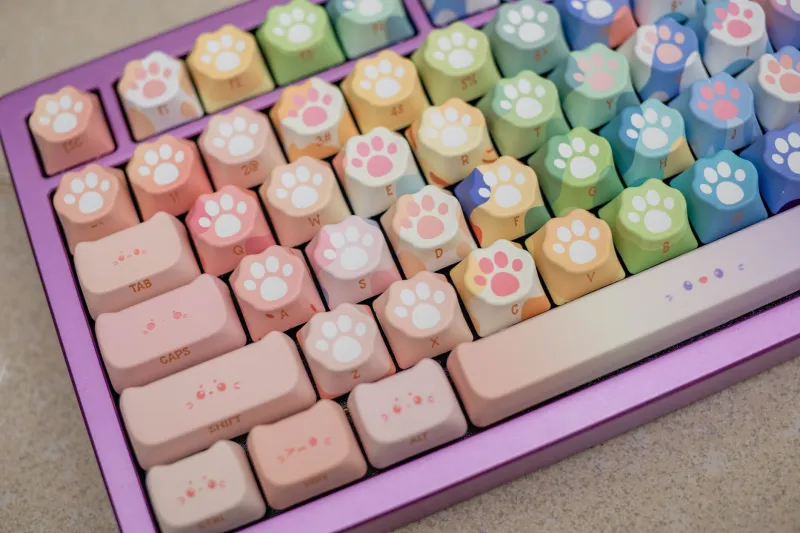
Artisan keycaps in particular are a fever dream. These are single, handmade caps — often featuring tiny sculpted characters, food, animals, or surrealist art — that sit on one key (usually Escape, because keyboards have a sense of humor) and cost anywhere from $30 to well over $100. For. One. Key.
And yet? The market is thriving. Because this hobby isn't just about gaming anymore. It's about expression. Customization. Building something that feels uniquely yours in a world of identical setups.
Signs You've Gone Full Keyboard Gremlin
Just in case you need a wellness check, here are some red flags that your "side hobby" has become a lifestyle:
- You've described a keyboard as having "good sound signature" without irony
- You own more than one type of lube and know which one to use on stabilizers vs. switches
- You've recommended a keyboard to someone who just wanted something "cheap and fine"
- You have a spreadsheet tracking your collection
- You've said the phrase "it's an investment" about a keyboard
- You're currently reading this article while your switches soak in a Frankenswitch experiment
No judgment here. Only solidarity.
The Aleloo Verdict
Look, at the end of the day, the mechanical keyboard hobby is one of the more chaotic, joyful, and surprisingly deep corners of gaming culture. Is it objectively necessary to spend $350 on a keyboard? Absolutely not. Will it make you a better gamer by default? Probably not.
But will it make every gaming session feel like you're piloting a spaceship designed specifically for your fingertips while the satisfying thock of each keypress serenades your soul?
Actually... kind of yes.
Just maybe set a budget before you open that first switch review video. For your own safety.